
$1.9 Trillion
53%
Burnout Isn't One Problem. It's Two. And Schools Can Address Both.
Every graduate you send into the workforce will face burnout, not as a possibility, but as a near-certainty. Research consistently shows it hits hardest in the first decade of a career, right when professionals are building the habits and patterns that will define how they work for the rest of their lives. But here's what most burnout conversations miss:
Front One: The Individual
Front Two: The Systems
This is where schools have a role no employer ever gets.You can reach them before the damage begins on both fronts.
Dr. Brandy Biglow Has Studied This Problem From Every Angle
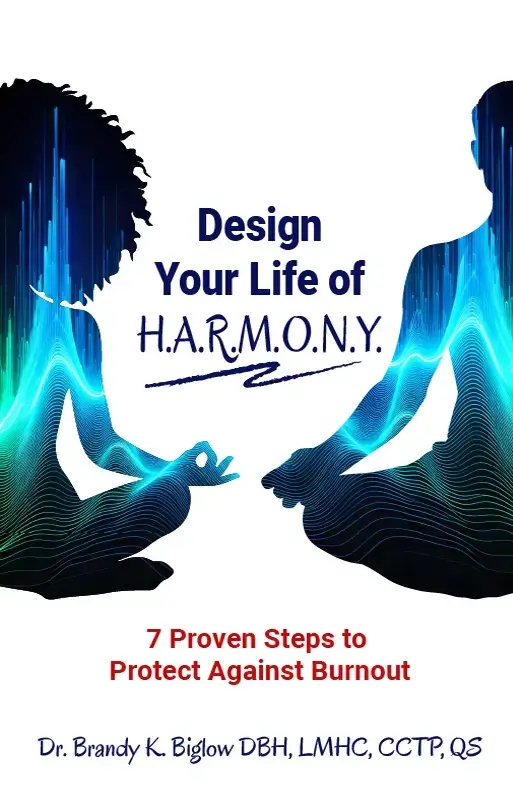
Dr. Brandy K. Biglow is a Doctor of Behavioral Health, a Certified Professional Life Coach, a Licensed Mental Health Counselor, Founder of Renovation Integrative Health, creator of the H.A.R.M.O.N.Y. Framework, and author of the Design your Life of H.A.R.M.O.N.Y. book.
She spent 25+ years moving through the systems that burn people out. First, as a special education teacher, a mental health counselor, and a program manager at a large non-profit.
She didn't just survive them. She spent her doctoral career researching exactly why they work the way they do.
What she found confirmed what she already knew from the inside: burnout is never just a personal failing. It lives in individuals, AND in the systems those individuals build and maintain.
That's why she developed the H.A.R.M.O.N.Y. framework, a clinically grounded, 7-step approach to burnout prevention that addresses both fronts. She wrote the book on it. She has applied it with executives, professionals, and organizations. And she is now bringing it into academic programs because the earlier it lands, the more it changes.

Three Ways to Launch Leaders That Last
You don't have to overhaul your curriculum overnight. Every option below addresses the individual and the future leader inside them. Start where it makes sense for your program.
Guest Lecture
Dr. Brandy brings the H.A.R.M.O.N.Y. framework directly to your students. They leave understanding burnout as both a personal and a systemic issue, and with real tools for both. High-impact, low-lift, and immediately applicable.
Best for: Programs exploring burnout prevention as a topic or looking for a meaningful stand-alone experience.
Full Course
A complete curriculum module where students move through the H.A.R.M.O.N.Y. framework in depth. They don't just understand burnout. They practice protecting against it as individuals and begin developing the leadership mindset to build systems that don't create it. Designed to integrate into existing programs without disruption.
Best for: Programs ready to make burnout prevention a defined, measurable graduate outcome.
Curriculum Integration
This is the full systems approach. Dr. Brandy works with your institution to embed burnout-resistant thinking across the arc of your program. By graduation, students aren't just aware of the two-front war. They've been training for it. They enter the workforce equipped to protect themselves and, in time, to build something better for the people they'll lead.
Best for: Institutions committed to graduating leaders who change the pattern, not repeat it.
You CAN Achieve Work-Life Harmony. Don't Believe Us, Believe Them!


Working with Brandy was such an eye-opener. I was able to focus on building my business and managing self-care to avoid burnout and build confidence. I have been able to set and exceed my goals and I was able to venture into a new career feeling empowered and motivated for success!
I got a signed copy from the author at a conference, and if you’ve seen her on YouTube or other social media, you can totally hear her talking to you as you read. Her mix of humor and expertise kept me turning the pages, and the H.A.R.M.O.N.Y. framework is practical, relatable, and easy to put into action. All I want to know is—when’s the Audible version coming?

I had the pleasure of attending a Compassion Fatigue session, and I was highly impressed. The presentation was engaging and informative. Brandy demonstrated a deep understanding of the topic, while delivering the ideas in a clear and relatable way. From start to finish the presenter engaged with the audience and kept their attention. Brandy's ability to connect with the audience and addressing questions thoughtfully made for a dynamic and stellar presentation. Final Thoughts: Excellent Speaker, Informative, and Engaged in the audience. -Dr. Robyn Napier, DBH, LCSW, MSSW

Brandy is absolutely brilliant... We discussed food alternatives to help with my sleeping, 30-minute exercise routines so I'm not so overwhelmed then quit, and better ways to listen to my son and niece when they need to vent about their day...just an all-around self-care process that left me feeling renewed and strengthened. I absolutely love that woman. If she ever writes a book I might have to superglue it to Michele Obama's Becoming. Yeah, she's on THAT LEVEL for me and my family.
I am lucky enough to have obtained a signed copy from the author!! It is a great, small and mighty, practical book! It gives you theory AND practice. It’s such an easy read, with summaries and exercises that prompt you to actually put into action the things that make so much sense in this book! If you’d like to prevent burnout, if you’re on your way, or already there get this book!

I worried sessions were going to be a waste of time. I was wrong. I made more progress in six sessions than I’ve made in ten years. I can't describe with words how happy I feel with your services! Thank you.
It is a rare thing to meet with someone as educated, compassionate, and dedicated to health as Brandy. From enabling clients to overcome burnout and move toward a fulfilling life to delivering burnout programs at corporations and conferences, Brandy is not only the type of professional you want on your side but is also the type of person who shares their energy and passion for health with you. Brandy is highly recommended!
This book is the written equivalent of putting your own mask on in case if an emergency on a plane. So often we forget to care for ourselves that we burn out caring for others. Living in H.A.R.M.O.N.Y. is such a simple yet powerful system to reframe our lives in the workplace!!!


Burnout Isn't One Problem. It's Two. And Schools Can Address Both.
Every graduate you send into the workforce will face burnout, not as a possibility, but as a near-certainty. Research consistently shows it hits hardest in the first decade of a career, right when professionals are building the habits and patterns that will define how they work for the rest of their lives. But here's what most burnout conversations miss:
With The BurnoutGuard Protocol
Without The BurnoutGuard Protocol


This is where schools have a role that no employer ever gets. You can reach them before the damage begins on both fronts. Let's talk about how you can prepare your students to guard against burnout before it ever takes root.
FAQ: Bringing Burnout Prevention Into Your Program
Not sure where to start with burnout prevention or work-life harmony coaching? You’re not alone. Whether you're curious about what a Doctor of Behavioral Health, or a Work-Life Harmony and Burnout coch is, how I can support your team, wondering what work-life harmony really means, or curious about our burnout prevention strategies—this FAQ section has you covered. We’ve answered the most common questions professionals, leaders, and organizations ask when they’re ready to create sustainable success without sacrificing well-being.
Isn't burnout a workforce problem? Why address it in an academic setting?
.webp)
That's exactly the point. By the time burnout becomes a workforce problem, the habits, patterns, and leadership behaviors that feed it are already set. Academic programs have a window that no employer ever gets, the chance to shape how future professionals think about their own wellbeing and how future leaders design the environments their teams work in. Waiting until graduation means handing that window to someone else.
Our curriculum is already packed. How does this fit without displacing what we already teach?
That depends on which option makes sense for your program. "The Spark" is a single session and fits alongside anything. "The Foundation" is designed to integrate into existing curriculum rather than replace it. "Build to Last" is a collaborative process where we work with your institution to find where burnout prevention fits most naturally, not where it causes the most disruption. The free 20-minute discovery call is specifically designed to answer this question for your program.
Is this just a wellness add-on? We've had those before and they don't stick.
No. Wellness programs treat symptoms. This addresses the two fronts burnout actually operates on; the individual and the systems leaders build. Students don't just learn stress management techniques. They learn to recognize burnout as a systemic issue, protect themselves from it, and when it's their turn to lead, build environments that don't create it in the first place. That's a fundamentally different outcome than a wellness workshop.
What is the H.A.R.M.O.N.Y. framework and how does it apply to students?
The H.A.R.M.O.N.Y. program is our signature approach to achieving work-life harmony. It includes actionable steps and strategies for maintaining health, managing responsibilities, and boosting productivity. For students, it provides a practical, repeatable framework they can apply from their first day on the job — and carry into every leadership role after that.
What are your qualifications and experience?
The short answer: this isn't her first classroom, and burnout isn't just a topic she researched, it's something she lived, navigated, and came out the other side of.
Dr. Brandy Biglow brings 12+ years of experience in mental health, coaching, and burnout prevention to every engagement. She began her career as a special education teacher, moved into mental health counseling, and served as a Clinical Program Manager leading mental health teams before dedicating her doctoral research to workplace burnout. She has spoken at academic and professional conferences, including DEAC, and was honored with the 2025 Outstanding Graduate Award from CGI.
Her credentials speak for themselves:
✔ Doctor of Behavioral Health (DBH)
✔ Master’s in Counseling & Licensed Mental Health Counselor (LMHC)
✔ Certified Group Coach (Priority Academy)
✔ Certified Life Coach (Transformation Academy)
✔ Certified Integrated Mental Health Professional
✔ Certified Clinical Trauma Professional (CCTP)
✔ Former National Certified Counselor (NCC)
✔ Qualified Supervisor (QS) for MHC & MFT Florida interns
✔ Former Clinical Program Manager, leading mental health teams
She doesn't teach burnout prevention from a textbook. She teaches it from experience (her own included.) That combination of clinical training, research, and personal history is what makes her approach land differently with students than a standard academic lecture ever could.
What does the guest lecture actually cover in 60 minutes?
In one session, students are introduced to burnout as a two-front war; personal and systemic. They will walk away with a foundational understanding of the H.A.R.M.O.N.Y. framework and how to apply it immediately. The session is engaging, evidence-based, and deliberately designed to make a difficult topic memorable. It's not a lecture in the traditional sense. Think of it as the kind of session students actually talk about afterward.
Can this be delivered virtually, or does Dr. Brandy need to be on campus?
Absolutely. Given that your students are already learning in a virtual environment, this is built for them.
All three options are designed for full virtual delivery. Dr. Brandy has extensive experience engaging online audiences and knows that virtual doesn't have to mean passive. The H.A.R.M.O.N.Y. framework translates directly to the screen. The sessions are interactive, the content is immediately applicable, and students leave with tools they can use the same day, whether they're logging in from a home office, a coffee shop, or anywhere in between.
For "The Build to Last," the consulting process is also fully remote. We'll collaborate with your team through virtual working sessions to identify where burnout prevention fits most naturally in your existing curriculum.
Your students chose a virtual program because it fits their life. This does too.
What does the pricing look like?
The Spark (Guest Lecture) is $3,297, or $2,997 if paid upfront. The Foundation (Full Course) starts at $10,997 depending on scope and delivery format. The Build to Last (Curriculum Integration) is a custom investment starting at $49,997. Scope, institution size, and implementation timeline determine the final number. The discovery call is where we figure out which option fits your budget and your program.
We're interested but the timing isn't right this semester. What should we do?
Book the discovery call anyway. The conversation takes 20 minutes and costs nothing. Understanding what's involved and what it would look like for your specific program puts you in a much better position to make the decision when the timing is right. The schools that move fastest on this are the ones that started the conversation early.